
I recently came back from BrightonSEO with a notebook full of takeaways from the many amazing talks I’ve had the pleasure to listen to. Amongst them, Richard Clifford's session “Is International SEO Dead in the Age of AI? Rethinking Global Strategy for AI Search” really stuck with me. It tackled a question I have been hearing more often from clients lately, particularly the ones under pressure to cut their localisation budgets. With ChatGPT, Gemini and other large language models pulling from high-authority global sources and translating content in real time, do multilingual websites still earn their keep?
The honest answer, after running multilingual sites for clients across the United Kingdom, Australasia, Italy and Spain, is yes, and I think the reasons are stronger now than they were three or five years ago, before the AI era. The fundamentals of international SEO have not gone anywhere, even if the layer sitting on top of them has changed considerably.
Three things I took from Richard Clifford's BrightonSEO talk
Everyone knows that search is evolving and it’s not just about a search results page in Google. This shift is very much true for anyone running international visibility. Google AI Overviews, ChatGPT, Perplexity, Gemini and Claude now read across the open web, choose a small set of sources to cite and produce a single response, which means users see fewer clicks, fewer brand impressions and fewer chances for your site to compete on its own terms.
Real-time translation has matured at the same time, and on the surface that looks like an argument against translating (or shall we say, localising) your site at all. A user in Madrid can ask ChatGPT a question in Spanish and receive a clear answer that draws on English-language sources, with the model handling the translation invisibly in the background.
However, the reality is more nuanced than that surface impression, and the nuance is where the entire argument turns. AI search engines still need to choose which sources to surface in any given response, and that choice is shaped by a number of factors like authority, topical relevance, structured data and language match in the specific market they are answering for. If your local market has thin coverage in its own language, the model fills the gap with whatever it can find, which in my experience is usually a competitor who took the work seriously.
The argument against multilingual investment is straightforward, and worth taking seriously before pulling it apart. If large language models translate on the fly, why pay translators? If users can prompt in their own language, why build separate sites? If AI Overviews summarise everything anyway, why optimise for a click that may never come?
There is definitely some truth in all of that and I will not pretend otherwise. Casual research queries do get answered by AI in any language without a click, low-intent informational pages will lose traffic, and maintaining ten language versions of a 200+ pages site is genuinely expensive, which means some businesses will rationally narrow their focus to the markets where the maths actually works.
The argument falls apart, though, the moment you separate the easy half of the job from the hard half. Translation is the easy half. Being chosen as the trustworthy source in a specific market is the hard half, and AI search has not removed the need for local authority on that front, it has raised the bar for what counts as authoritative when a model is deciding between you and the competitor down the road in Auckland or Madrid.
People still buy in their own language, and the data has been remarkably consistent on this for years. A survey of 8,709 consumers across 29 countries found that 76% of online shoppers prefer to buy products with information in their native language, and 40% will never buy from websites in other languages. The same body of work also shows that 65% prefer content in their own language even when the quality is poor, which tells you how strong the underlying preference really is.
Trust does not move across languages as easily as text does, and most businesses underestimate the work involved. Buyers read tone, currency, units, address formats and legal language to judge whether a brand takes their market seriously, and an auto translation plugin rarely passes that test.
AI search engines reward the same signals a careful human would reward, and the overlap is not coincidental. When a model decides which sources to cite for a Spanish query, it weighs topical relevance, domain authority, language match, site structure and freshness in the target market, which means a native Spanish page on a Spanish-targeted site outperforms a machine-translated page sitting under the English domain, even when the underlying content reads as identical to a casual eye.
Regulatory and cultural fit close the case, particularly in regulated industries. Disclaimers, returns policies, GDPR notices, pricing and tax handling all need genuine localisation rather than literal translation, and getting any of these wrong in a regulated market turns your site into a liability rather than a marketing channel. I have seen this play out in finance and health more than once.
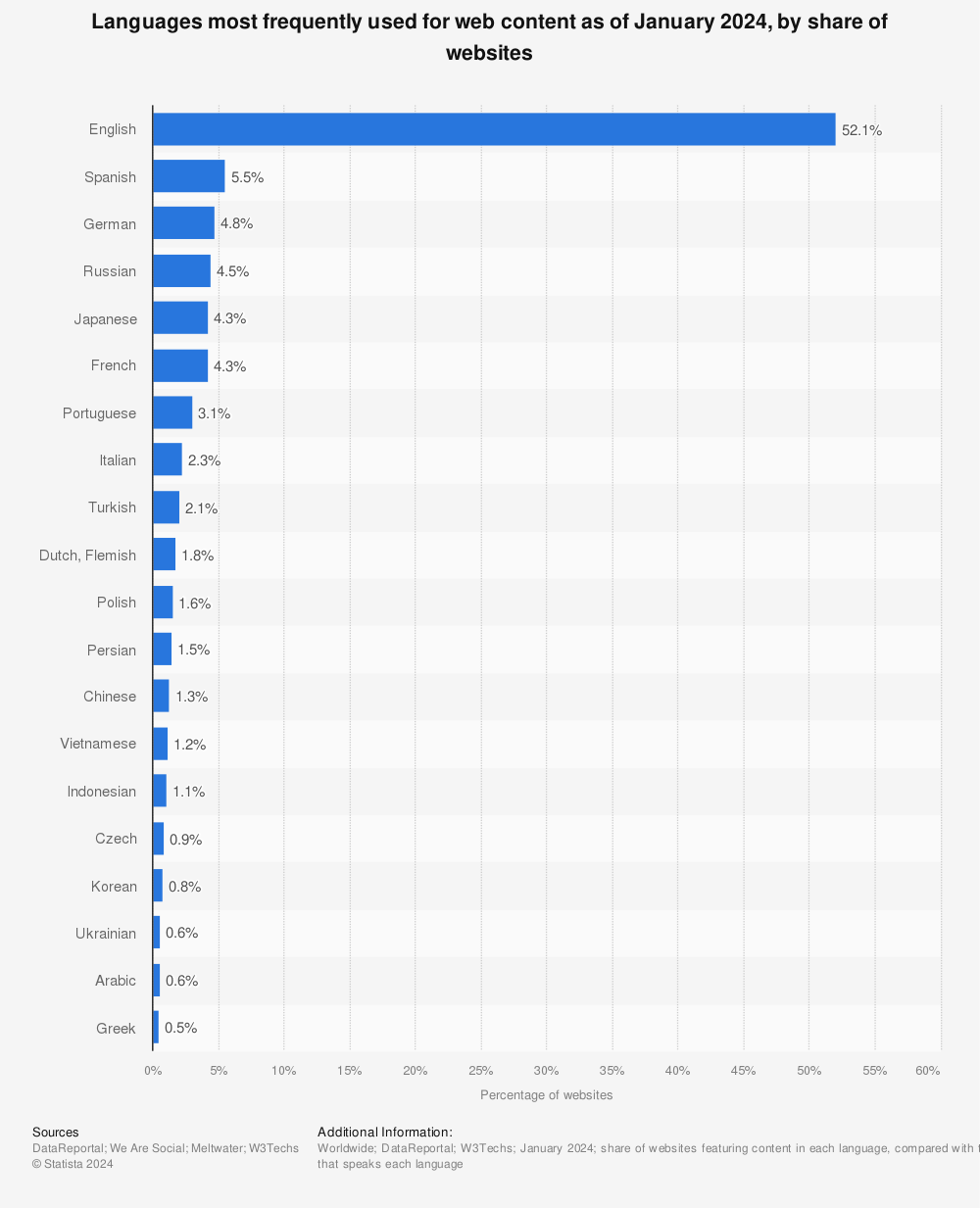
English still dominates the open web by a wide margin, and that imbalance shows up everywhere AI gets trained. As of October 2025, English is the content language of nearly half of all websites worldwide, with Spanish in second place at around 6% and German at 5.9%, which means the data large language models train on is heavily skewed before any other variable enters the picture.
The bias is not just an academic concern that can be set aside. Researchers found in 2025 that popular large language model tools amplify the dominance of English and create what they call information cocoons across languages, which is to say that the language a user prompts in shapes the information they get back, and the gap between languages is wider than most marketing teams realise.
Output quality also varies by language in ways that affect how AI surfaces local content. Testing of GPT-4 across 16 languages showed stronger results for higher-resource languages such as English, German and Spanish, with noticeable drops in lower-resource languages including Korean and Chinese. For SEO this matters, because the model's working idea of what counts as a good answer in a given market is shaped by its training data, and that data continues to favour English-language sources by default.
The practical takeaway is that an English-only site in 2026 is competing for AI citations against multilingual rivals in markets where the model already prefers more local sources, and that gap will not close on its own without deliberate work.
AI translation is genuinely useful for parts of the workflow, and I use it daily across my own work. It is fast, cheap and good enough for first drafts, internal documents, content scaffolding and bulk metadata work, and I would not run an international SEO programme without it today.
The problems start when teams treat raw output as final copy. Tone is usually the first thing to go, and it is harder to spot than a mistranslation, because the words can all be technically correct while the voice goes flat. Idioms, formality registers, brand voice and humour rarely survive a model's pass intact, and a Kiwi software brand that sounds confident and dry in English can read as generic and forgettable in Italian or Spanish.
Structural SEO elements break in small ways that add up over time. Anchor text loses keyword relevance, internal links point to pages that may not exist in the target language, schema fields keep their English values and title tags overflow when translations run longer than the original. None of those issues are fatal on their own, but together they signal a site that has been processed rather than built, and search engines are increasingly good at spotting that difference.
Product, legal, medical and financial pages sit in what Google calls Your Money or Your Life territory, where the cost of a wrong word is genuinely high for both the reader and the brand, and I would not advise any client to use machine output in those areas. A misrendered ingredient list, returns clause or compliance statement is worse than no translation at all, and these pages need a market-fluent human who can put their name to the accuracy of the final copy.
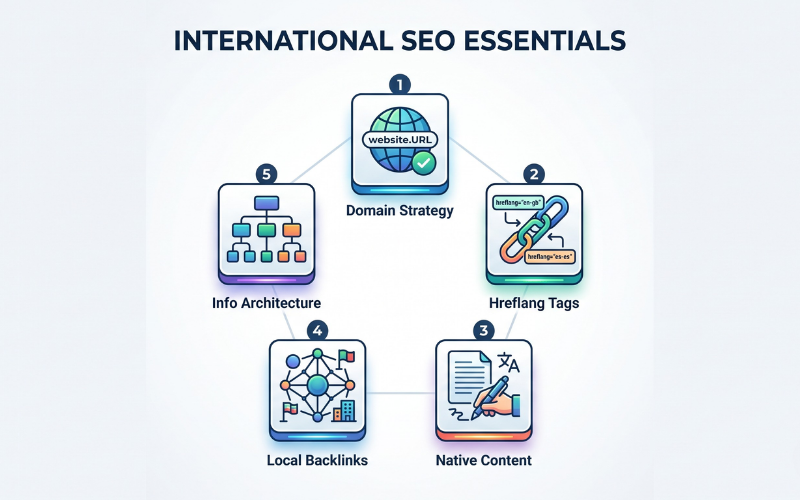
Strong international SEO sits on five pillars in my experience, and they all need attention if you want the work to compound rather than leak.
Domain strategy comes first, because the choice between country-code top-level domains, subdirectories or subdomains shapes everything that follows. Subdirectories on a strong root domain are usually the best balance of authority transfer and management cost for smaller businesses, with country-code domains reserved for markets where local trust is genuinely decisive and the brand can support the additional infrastructure that comes with running them properly.
Hreflang sits second, and the implementation is genuinely unforgiving, which is why it remains the most common technical failure in the audits I run. A single broken pair can pull pages out of the right country results, and I keep finding misconfigured tags that have been bleeding rankings for months without anyone on the in-house team noticing.
Native content is the third pillar, and this is where most multilingual programmes either pay off or fall down. Use AI to draft, then bring in a market-fluent editor or writer to rebuild the copy properly. Localise the angle as well as the words, because a landing page that converts in New Zealand may need a different structure to convert in Germany, where buyers want more proof and more detail upfront before they will engage with anything resembling a sales conversation.
Local backlinks and digital PR come fourth, and they pull more weight than they used to now that AI search is in the mix. AI search engines weigh local authority signals heavily, and coverage in the target market's press, partnerships with local sites and listings on country-relevant directories all feed that signal in ways an English-language link profile alone cannot replicate, however strong it might be on its home turf.
Information architecture closes the list, covering internal linking, schema, currency, units, contact details and trust badges, all of which need to be set up per market rather than bolted on after the fact. This is also the part most often skipped in cheap multilingual builds, which is why those builds rarely perform the way the brands behind them hope they will.
The most common mistake I run into is treating auto-translation as a strategy in itself. A WordPress plug-in that translates text on the fly is fine for an internal tool, but it has no business being the engine behind a site you want to rank and convert in another country, however much the agency selling it wants to tell you otherwise.
Cloning the English site structure across markets is the second mistake, and it is more common than you would think among brands that have outsourced their localisation to a translation tool. Search intent, query patterns and competitor sets vary by country in ways that matter, and a page targeting the term "international SEO consultant" in New Zealand may need a different angle, supporting content and internal links to compete in Spain or Italy, where buyer behaviour and the competitive landscape look different on the ground.
Hreflang errors are the third recurring problem I usually face, and they tend to look unglamorous on paper while doing real ranking damage when left unchecked. Bidirectional tags missing, x-default omitted, language codes mismatched, regional variants confused with language variants, all of it the kind of issue a properly configured site never has to think about, and the kind of issue a poorly configured site never quite recovers from.
Skipping local link acquisition is the fourth, and it gives the game away faster than anything else on the list. A Spanish version of your site with zero Spanish-language backlinks looks exactly like what it is, a translated version of an English site rather than a real presence in the market.
Ignoring AI search behaviour is the fifth, and it is the newest one on the list, which is part of why it gets missed by teams who are still measuring what they were measuring two years ago. Brands that are not surfacing in their local market's AI Overviews or ChatGPT answers should be tracking that gap as carefully as they track organic rankings, because the visibility cost of being absent compounds quickly once buyers start treating AI assistants as their first port of call.
The decision usually comes down to four factors in my conversations with founders. The number of markets in play, the regulatory exposure of your sector, the conversion sensitivity of the pages involved and the in-house capability you already have on the team.
One or two markets, low regulatory exposure and a strong in-house team can often run multilingual SEO with consultancy support, and that is a perfectly viable model when the people inside the business already understand what good looks like. Once you are running three or more markets, handling regulated content or selling into sectors like finance and health, the case for hiring a multilingual SEO expert becomes hard to argue against because the cost of getting the basics wrong scales faster than the cost of getting them right ever will.
International SEO fundamentals and best practices are very much alive and Richard Clifford's talk reinforced that for me rather than challenged it. Topical relevance, local authority, native content, market-specific intent and technical hygiene still do the heavy lifting in any market that matters to your business, and none of that work has been replaced by AI translation or AI search, however much the loudest voices on LinkedIn might suggest otherwise.
What has been added on top is a new layer of visibility that increasingly decides who gets cited when a buyer asks a question in their own language, and that decision rewards the same fundamentals SEO has always rewarded, except that the consequences of getting them wrong now play out faster and more visibly than they used to. The brands I see winning are the ones treating AI search as another reason to do international SEO properly, not an excuse to do less of it.
The honest test for anyone reading this is to ask whether a high-intent buyer in your target market, asking an AI assistant a question in their own language tomorrow, would have any real chance of seeing your site cited as the source. If the answer is anything other than a confident yes, that is the work in front of you and coincidentally, that is what good international SEO looks like in 2026.
If you are looking for an international and multilingual SEO expert to help your business compete across markets, get in touch with Origin SEO.