When browsing on LinkedIn, I keep seeing the same sort of post almost on a daily basis now, usually from a so-called SEO guru or an influencer with a large following. The posts roughly say "I sacked my SEO team [or my SEO agency] and replaced them with 12 Claude agents costing £25 a month" and now claim to produce the same work in a fraction of the time. Underneath sits a screenshot of a dashboard with agents named things like Technical Auditor and Content Strategist, then the hook: "Comment SEO and I will send you the template". The engagement is always striking. Thousands of likes, hundreds of comments, and a meaningful share of them from SEO professionals who understand the craft well enough to know better.
I understand why these posts have such a high engagement. Agency retainers are expensive, the demo looks convincing and the promise arrives at a moment when everyone feels pressure to do more with less. But I have spent over 15 years in this vertical and I use Claude almost every day on my own client projects, which is exactly how I know where these tools break down. The businesses that follow the template rarely post about what happens six months later. I know what happens because I am often the person ending up auditing the damage.
Before going into detail, it helps to see the whole picture. These are the parts of the work that automation has not solved, and in most cases cannot solve:
The first four deserve proper explanation, because they are where I see automated setups fail most consistently.
Context separates SEO activity from SEO results, and this is the first thing lost when the work moves to an agent. A tool can tell you that a page has a thin word count or a missing heading. It cannot tell you that this particular page converts at four times the site average, that your sales team sends prospects to it during negotiations or that a migration two years ago left indexing problems that still shape what is possible today.
I reviewed an automated audit that recommended consolidating a group of category pages on an online retail site. The reasoning looked sound on paper, since the pages overlapped semantically and the tool had flagged them as competing with each other. However, those pages happened to carry the majority of the store's organic revenue and nobody in the process had the commercial context to notice. Following the advice would have cost the business more than a year of SEO fees.
Language models generate confident answers whether or not the underlying facts exist, and better prompting does not remove this. The Tow Center for Digital Journalism tested eight AI search tools and found they returned incorrect answers to more than 60 per cent of queries, usually presented with no signal of uncertainty at all.
What that means in practice deserves a deeper thinking. An agent that invents a technical problem sends your developers chasing something that was never there, which is expensive but at least visible. An agent that invents a positive finding causes more damage, because a clean report hides the real problems and you stop looking for them. Either way you are making decisions based on hallucination, and without a human verifying the work there is no reliable way to tell which parts of the report describe your actual website.
Understanding why someone searches matters far more than matching the words they typed. A query like "best accounting software" might come from a founder ready to buy, a bookkeeper comparing options for a client or a student writing an assignment, and the page that wins depends entirely on which of those Google has chosen to serve. Reading that correctly means looking at the results, understanding the market and knowing the customer.
Automation matches patterns instead. It takes a keyword, maps it to a template and produces a page shaped like the pages already ranking. It does not notice that results in London differ from Edinburgh, that a query drifted from informational to commercial over the past year or that the genuine opportunity sits in a question nobody has answered properly yet. I find those gaps by reading search results and talking to clients, and that work has resisted every attempt I have made to automate it.
Backlinks worth having come from people making an editorial decision. A publisher links to you because an editor trusts the source, the content earns the reference and someone made a credible case at the right moment. Every element of that exchange is human.
An agent cannot build a relationship with an editor, negotiate a placement or judge whether a publisher genuinely suits your industry. What automated outreach produces at scale is a flood of template emails, and editors identify them immediately. The sites willing to respond to that kind of approach are, almost by definition, the ones whose links carry no weight, while your brand name gets attached to spam in front of the publishers who actually matter.
Google names this behaviour directly in its guidelines. Scaled content abuse, producing large volumes of content primarily to manipulate rankings, sits in the published spam policies alongside link spam, and enforcement is real rather than theoretical.
Here is a site I have been reviewing, hit by the September 2025 spam update.
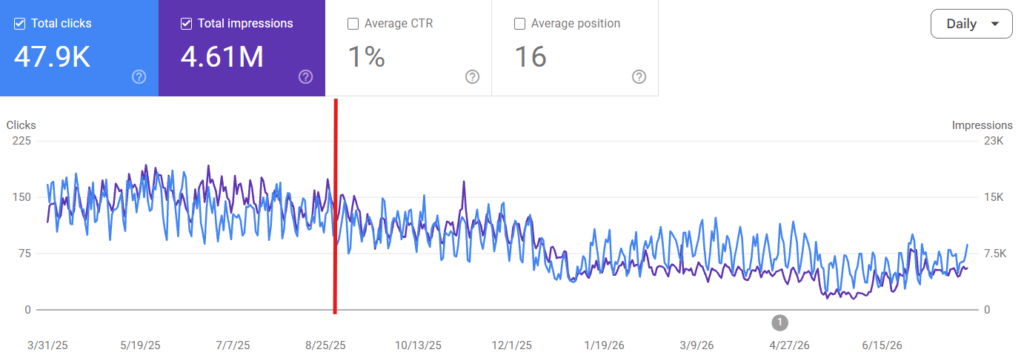
Clicks roughly halved within weeks of the update rolling out, then continued sliding through the months that followed. Ten months on, the site sits close to 70 per cent below where it started and impressions have taken the same path down. Recovery has just started, after two months of proper SEO work.
The cause appears clearly in the indexing report. The business had used AI to generate a large number of gateway pages, each targeting a small keyword variation while carrying essentially the same content underneath.

More than 2,914 pages crawled and left out of the index, alongside 1,840 that haven't been crawled at all. In the first group, Google crawled all of it, found nothing distinct and declined to index the pages. In the second case, it didn't even bother crawling them. In the meantime they consumed crawl budget, diluted the site's topical signals and dragged quality assessment down across the entire domain. Publishing them took an afternoon. Undoing the damage will take months, although there are early signs of recovery.
I use AI on a daily basis, which is why I want to be precise about this argument. Claude helps me draft content that I then rework, verify and rewrite in my own voice. It handles repetitive technical tasks while I supervise them. I also connect tools such as Screaming Frog, Ahrefs and DataForSEO through MCPs, short for Model Context Protocol, a connection standard that lets me pull and blend data from those platforms directly rather than exporting spreadsheets out of three separate interfaces.
The pattern holding all of that together is simple enough. AI removes friction from the work without doing the work. Strategy, interpretation, verification and relationships stay with me, because every output eventually feeds a decision that a human has to answer for. Used this way, AI makes an experienced consultant considerably faster. Used as a replacement, it makes an inexperienced operator dangerous at scale.
I am not going to pretend this will hold true forever. Every trade eventually meets the technology that replaces it and the people doing the work are usually the last to admit it is coming. Chimney sweeps were a respected trade for centuries until clean heating made them unnecessary. Shoe shiners had a stand on every corner of every major city and then the shoes changed and the corners emptied. Lamplighters walked the same route each evening for generations until somebody installed a switch.
It is entirely possible that SEO consultants join that list. Perhaps in ten years the models will hold enough context, judgement and restraint to run the discipline without supervision and this article will read like a lamplighter explaining why electricity will never catch on.
But that day has not arrived. Today the models still invent findings, still misread intent, still cannot pick up the phone to a publisher and still have no real idea what your business is trying to achieve. Until that changes, the difference between a site that grows and a site that quietly disappears from the index comes down to how the work is actually done and who is accountable for it.
Whoever handles your SEO, hold them to the standards automation cannot meet. A senior person should look at your site personally, explain recommendations in terms of your revenue rather than tool scores, verify findings before you act on them and take responsibility when something goes wrong. Asking those questions filters out the template sellers within minutes, and any consultant worth hiring will be glad you asked.
The posts will keep coming and the engagement will keep rolling in, because a £25 shortcut is an easier thing to sell than years of accumulated judgement. What decides your rankings is a separate question entirely.
If you want a second opinion on whether automation is helping or harming your site, get in touch for a free top-level SEO evaluation.